USDAI
USDAI is a synthetic dollar protocol which earns yield by providing liquidity to emerging AI companies who have real collateral but aren't OpenAI or Blackstone.
USD.AI - A synthetic dollar protocol for emerging AI companies.
Introduction to USDAI, USD AI and USD.AI crypto
USD AI and related products are emerging as core components in the AI + crypto funding stack. Unlike traditional bank dollars, USDAI refers to a new class of synthetic dollars designed to fund artificial intelligence infrastructure, DePIN networks, and real-world assets through on-chain protocols.
USDAI crypto ecosystem combines hardware-backed credit from GPUs and compute resources with decentralized governance and transparent reserves. This yield bearing version backed by productive assets positions USDAI crypto as more than a simple stablecoin - it is a tradable instrument targeting 13-17% APY and aiming for a 15-25% APR, functioning like a high-yield bond index tied to income-generating infrastructure equipment.
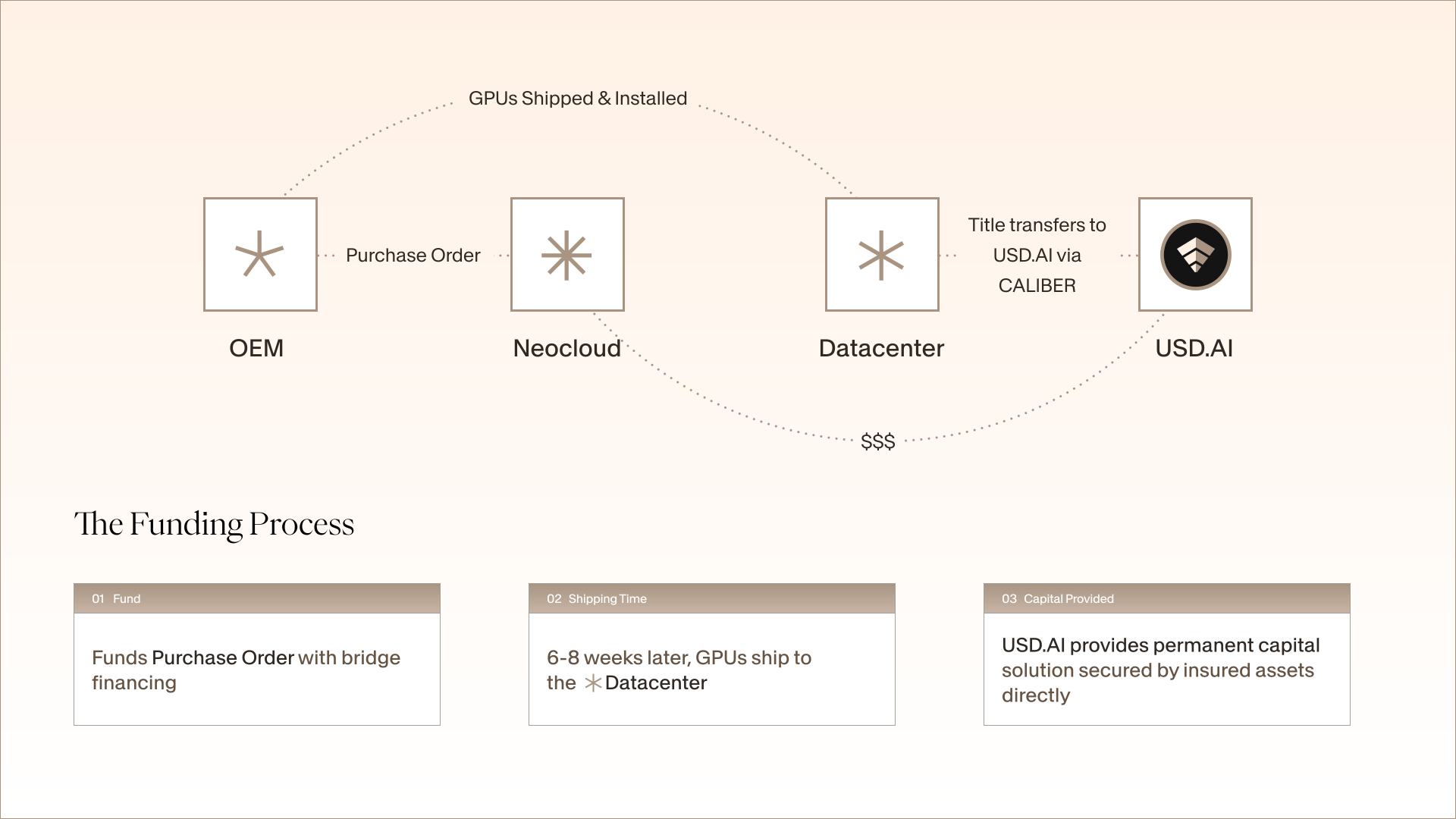
USDAI combines on-chain dollars with AI infrastructure lending economics.
Key facts about USD AI:
- Dollar-pegged synthetic asset operating on Ethereum, Arbitrum, and Base.
- Collateralized by revenue-generating AI hardware and T-Bills, including tokenized NVIDIA GPUs via the CALIBER framework.
- Market capitalization around $309 million, ranked #126 on CoinGecko, with multi-million daily trading volume of approximately $2.15 million.
- Total Value Locked (TVL) exceeded $500 million as of late 2025.
- CHIP governance token ICO confirmed for Q1 2026 at $300M FDV.
How USDAI and USD.AI Work as AI-Backed Synthetic Dollars
Users mint USDAI by depositing stablecoins like USDC into protocol vaults. These deposits fund loans secured by AI hardware - GPU clusters, data centers, and edge nodes deployed since 2023. The protocol then lends capital to companies building AI infrastructure for training and inference workloads.
Core mechanisms include:
- Collateral vaults holding tokenized GPU assets and T-Bills.
- Arbitrage systems maintaining the soft peg near $1 USD.
- On-chain treasuries providing real time visibility into reserves.
- Borrowing/lending markets where collateral ratios stay above safe thresholds.
- Queue Extractable Value (QEV) system enabling smart exits and faster loan processing to prevent traditional bank-run scenarios.
This forms a process where hardware generates revenue from AI tasks, repaying loans and funding yield distribution to users.
Collateral Design: GPUs, Compute and Real-World Assets Behind USDAI
The USD.AI protocol backs its synthetic dollar with productive, revenue-generating hardware rather than fiat reserves in banks.
Collateral types supporting USDAI:
GPU Collateral
High-performance GPUs (A100, H100, L40S) deployed in clusters since 2023, treated like tradable commodities facilitating loans to smaller AI infrastructure companies.
DePIN Assets
Distributed bandwidth, storage nodes, and compute infrastructure as productive collateral support.
T-Bills and Data Center Assets
Tokenized T-Bills provide stability while data center equipment generates income from AI training and inference.
This design contrasts with PYUSD or USDT, which depend on traditional banking relationships. The $200M GPU facility partnership with Tokyo-listed Quantum Solutions demonstrates how these loans create proof of real-world asset backing.
USDAI vs sUSDai, susdai and Other Yield-Bearing Variants
The base USDAI token serves as a non-yielding, instantly redeemable dollar for liquidity and trading. The yield bearing version - sUSDai or susdai - allows holders to earn yield from protocol income through auto-compounding mechanisms.
- USDAI: Dollar-pegged, liquid, no lock-up required.
- susdai: Staked version earning 13-17% APY from GPU loan repayments, with potential returns up to 20% APY due to revenue-generating AI hardware backing.
- Unstaking: 30-day queue aligns with loan liquidity cycles.
- Risk profile: Higher yields carry smart contract and collateral risks, including GPU hardware depreciation and AI compute operator performance risks.
Compare this to PYUSD money-market strategies offering 4-5% APY. The AI-linked economics of susdai can deliver structurally higher returns for investors who understand the complexity.
On-Chain Transparency, Verified Reserves and Security of USD AI Tools
The USD AI protocol prioritizes on-chain visibility through dashboards at app.usd.ai showing wallets holding collateral, outstanding loans, and utilization ratios.
- Oracle-free infrastructure eliminating price manipulation.
- Flash-loan protections and immutable contracts with time-locked upgrades.
- Hardware attestation for GPU clusters via external verification.
- Decentralized underwriting where independent experts vet every borrower and asset before minting, ensuring only high-quality hardware backs the protocol.
- Monthly audit cadence for reserve accuracy.
- Borrower default protection by repossessing and liquidating physical hardware to protect depositor capital.
Pendle Allo USDAI and DeFi Integrations (allo game USDAI, LPs, and Yield Strategies)
Liquidity Provision: Users provide USDAI in Curve/Balancer-style stable pools paired with USDC, earning trading fees and emissions. Deep liquidity enables tighter spreads and faster access for all participants.
Yield Trading: The pendle allo USDAI integration launched in Feb 2026 allows users to tokenize future yields via YT Lock Vaults. This creates opportunities to separate principal and yield components for leveraged strategies.
Incentive Campaigns: The allo game USDAI mechanism rewards users who lock USDAI in pools with Allo Points redeemable for CHIP airdrops. Season 2's Level Up campaign offers a 3% supply share through governance participation and vote gauges. The Token Generation Event (TGE) is expected in March, marking a key milestone for token release and initial trading.
Practical 2026 strategies include depositing susdai into Pendle for 15%+ boosted yields or using USDAI as collateral to borrow other assets.
Market Data, Trading Volume and Liquidity for USDAI crypto
As of early 2026, USDAI crypto trades on decentralized exchanges across Arbitrum, Ethereum, and Base, with CEX listings including MEXC. The most popular exchange to buy and trade USDai is Fluid (Arbitrum).
- Circulating supply: supporting multi-million USD daily volume.
- Market cap: approximately $309 million, ranked #126 on CoinGecko.
- Trading volume: around $2.15 million daily.
- Price stability: maintained peg around $1 through deep liquidity.
The PayPal integration enabling $1B in PYUSD deposits at 4.5% yield has accelerated TVL growth, positioning USDAI for increased institutional interest through the calendar year.
Global Reach and Adoption of USDAI to Build AI
USD.AI has rapidly established itself as a cornerstone in the global AI and fintech ecosystem, leveraging artificial intelligence and blockchain technology to bridge the funding gap for emerging AI companies. By offering a yield bearing version backed by real-world AI hardware and compute resources, the protocol enables companies to access capital efficiently, while providing investors with opportunities to earn yield in a fast-growing sector.
One of the standout features of USD.AI is its ability to operate across multiple jurisdictions, linking companies and investors from around the world. This global reach is supported by a robust protocol that delivers real time data, actionable insights, and transparent proof of collateral, ensuring users can make informed decisions with confidence.
With a circulating supply exceeding 310 million tokens and consistently high trading volume on decentralized exchanges, USD.AI has become a major liquidity provider in the market. Its yield bearing version has attracted significant interest from both retail and institutional investors.
Risks, Regulatory Context and How USD.AI Fits into the Stablecoin Landscape
Primary risks to consider:
- Collateral depreciation if AI hardware revenues slow or compute demand cycles.
- Smart contract vulnerabilities despite audits.
- Governance attacks via CHIP DAO.
- Liquidity crunches during market stress.
Regulatory frameworks in the US and EU continue evolving. The USD.AI protocol may classify as an asset-backed synthetic with RWA exposure - distinct from fiat-custodied stablecoins.
Best practices for due diligence:
- Monitor on-chain dashboards and loan performance.
- Verify contract addresses through official link sources.
- Diversify exposure across protocols.
- Track governance proposals before they go to vote.
How to Get Started with USDAI and USD.AI Crypto in 2026
Getting started with USDAI:
- Set up a Web3 wallet (MetaMask, Trust Wallet).
- Bridge funds to Arbitrum or Ethereum via aggregators.
- Acquire USDAI through reputable DEXes using USDC.
- Stake for susdai to access yield bearing returns.
- Verify official contracts and avoid phishing link scams.
Use cases include dollar-denominated savings, DeFi collateral, or DAO treasury management. Monitor positions through app.usd.ai dashboards showing APYs, collateral health, and governance activity in real time.
The Role of USDAI in Funding Global AI and DePIN Growth
Looking toward 2030, USDAI and USD.AI style synthetic dollars could become essential funding rails for GPU clusters, inference APIs, and DePIN networks globally. Protocol expansion may include renewable energy assets, data marketplaces, and cross-chain deployments with institutional-grade tranches.
Innovations like advanced underwriting and real-world credit scoring developed since 2023 can make these products more resilient than early experimental stablecoins. The sale of CHIP tokens and ongoing ICO activity signals continued ecosystem growth.
For users willing to learn the mechanics and accept RWA exposure, USDAI offers a compelling investment thesis: scalable AI funding, transparent on-chain credit, and accessible yield built on the future of artificial intelligence infrastructure.